


November 11, 2026

36

37:10
The Best CFOs Are Architects, Not Just Historians: How to Make the Shift, with Sam Monti
Listen on


Play Video

Most companies don't struggle because they lack ideas. They struggle because they spread their resources across too many of them.
Sam Monti, CFO of SolarWinds, has spent more than 35 years working across finance and operations, including leadership roles as a CEO and COO. Throughout his career, one lesson has remained consistent: the companies that succeed are the ones that know how to operate efficiently, allocate capital effectively, and stay focused on what actually drives growth.
In this episode of The Growth-Minded CFO, Sam joins Alex and Lauren to discuss why operational efficiency is the foundation of sustainable business growth, how the Rule of Three can transform strategic decision-making, and why recurring revenue should guide decisions across every department. He also shares how direct leadership can help companies navigate difficult situations, why AI is a productivity tool rather than a replacement tool, and how the CFO role is evolving into one of the company's most important strategic positions.
Operational Efficiency Is What Separates Good Companies From Great Ones
Sam believes companies often misunderstand what actually drives business performance. While financial results are important, the operational decisions behind those results are what ultimately determine whether a company can scale and sustain its growth.
As Sam puts it, "like wars are won by logistics not weapons, business is won by operations, actually, not by what people think."
For him, operational efficiency is about more than reducing expenses or improving margins. It's about building an organization that can consistently deliver better products, serve customers more effectively, and scale without creating unnecessary complexity.
That requires finance leaders to look beyond the numbers and understand how the business actually operates. Where are resources being wasted? Which processes are slowing teams down? Are the systems in place helping the company adapt quickly as priorities change?
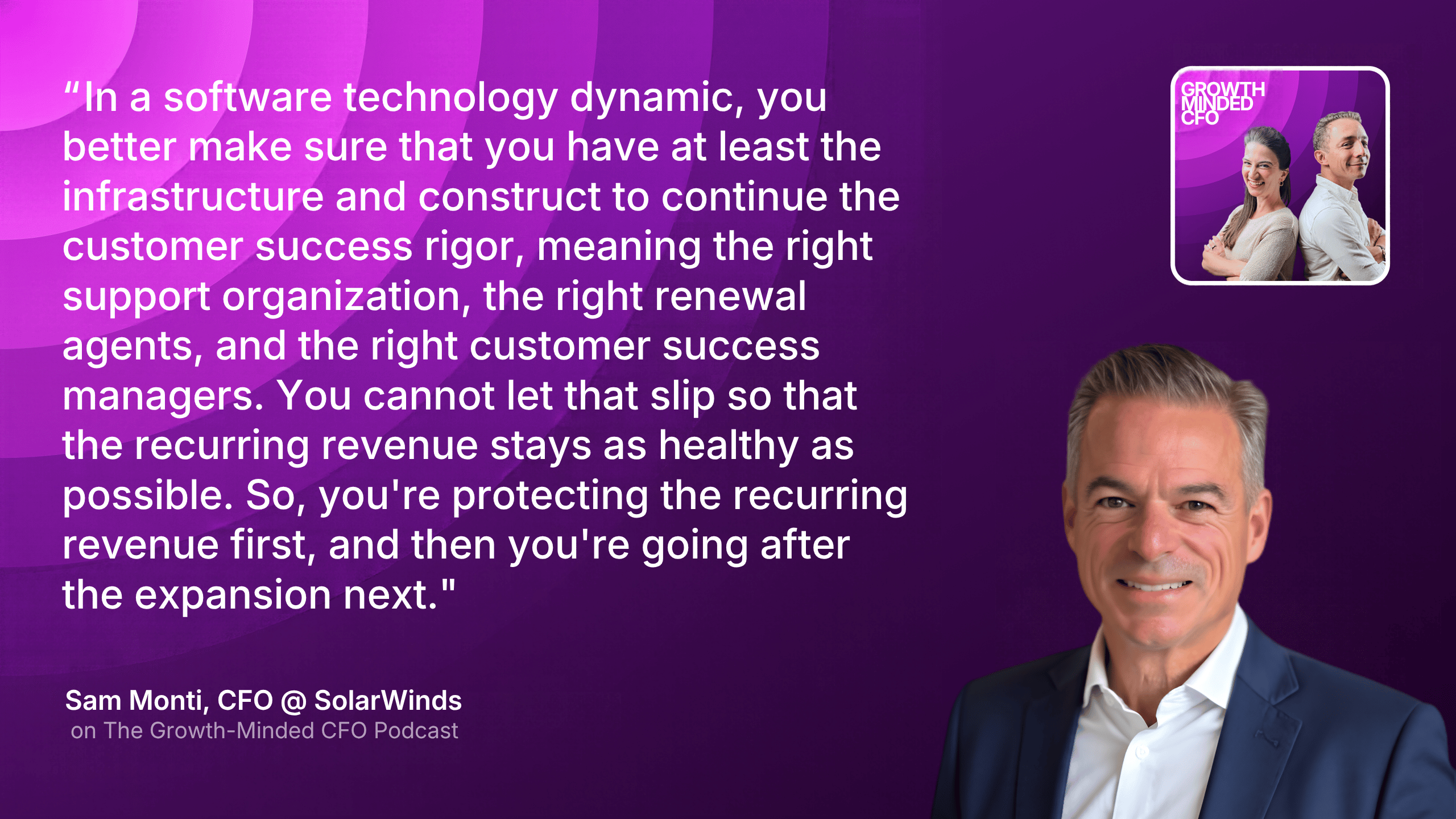
When operations become more efficient, the company creates additional capacity. That capacity can then be reinvested into the areas that matter most, whether that's product development, sales, customer retention, or expansion.
Sam sees this as a fundamental relationship between operational efficiency and capital allocation. The more efficiently a company operates, the more resources it has available to invest in growth.
For CFOs, this means financial performance shouldn't be viewed as a standalone outcome. It should be the result of an organization that knows how to deploy its people, capital, and resources effectively.
The Rule of Three: Why Great Companies Focus on Just Three Priorities
One of Sam's strongest beliefs about business strategy is that companies should never have more than three major priorities.
He calls this the Rule of Three, a framework built around the idea that organizations are far more likely to succeed when they concentrate their capital, energy, and resources on a small number of clearly defined objectives.
Companies that try to pursue 10 or 12 strategic initiatives simultaneously often end up spreading themselves too thin. Resources become fragmented, teams lose focus, and execution suffers.
Sam points to Henry Singleton, the founder of Teledyne, as an example of a leader who understood the importance of disciplined capital allocation. Singleton believed his responsibility as CEO was to deploy the company's capital as effectively as possible. That meant being deliberate about where money went rather than automatically following conventional investment practices.
The same principle applies to how companies approach their broader strategy.
Sam believes the most successful organizations identify one, two, or three priorities and become exceptionally focused on executing them. When those priorities are clear, every department has a framework for evaluating its decisions.
One question becomes particularly important: If what we're working on doesn't help the strategy, why are we working on it?
This is especially valuable for CFOs, who are responsible for helping the organization make difficult decisions about where to invest and where to pull back.
Rather than approving incremental spending across a dozen initiatives, finance leaders should challenge whether each investment contributes to the company's most important objectives.
The goal isn't simply to do fewer things. It's to concentrate resources where they have the greatest potential to generate returns.
The Three Metrics That Should Guide Every Department in a Software Business
For software companies, Sam believes nearly every strategic decision can be connected to one overarching objective: growing annual recurring revenue (ARR).
He refers to this as the ARR triad, which consists of three fundamental drivers:
- Gross retention: Keeping existing customers and protecting the recurring revenue already coming into the business.
- Price increases: Generating additional revenue from the existing customer base through pricing improvements.
- Customer expansion: Growing the customer base and increasing the revenue generated from existing customers.
Sam believes these metrics should influence decisions across the entire organization, not just the finance or sales departments.
For example, HR should evaluate its hiring decisions based on whether the organization is bringing in the right talent to support business performance. Product teams should consider whether what they're building delivers a return on investment and aligns with customer demand. Operations and finance should focus on creating scalable systems that allow the company to adapt as its strategy evolves.
Each department should be able to connect its activities to the outcomes that drive recurring revenue.
This creates a much clearer framework for evaluating investments. Instead of measuring success through departmental activity alone, leaders can ask whether their teams are actually contributing to customer retention, pricing power, or expansion.
For CFOs, this also changes the nature of financial oversight. Rather than simply reporting on performance after the fact, finance becomes a partner in identifying which activities are driving growth and which ones aren't producing meaningful returns.
AI Is a Productivity Tool, Not a Replacement Tool
As AI continues to change how companies operate, Sam believes finance leaders should approach the technology with curiosity rather than fear.
He sees AI as a massive productivity opportunity, not simply a tool for reducing headcount or replacing employees.
In his experience, AI allows talented people to accomplish significantly more work, often with greater accuracy and better results. More importantly, it gives employees additional time to focus on the parts of their jobs that require judgment, creativity, and problem-solving.
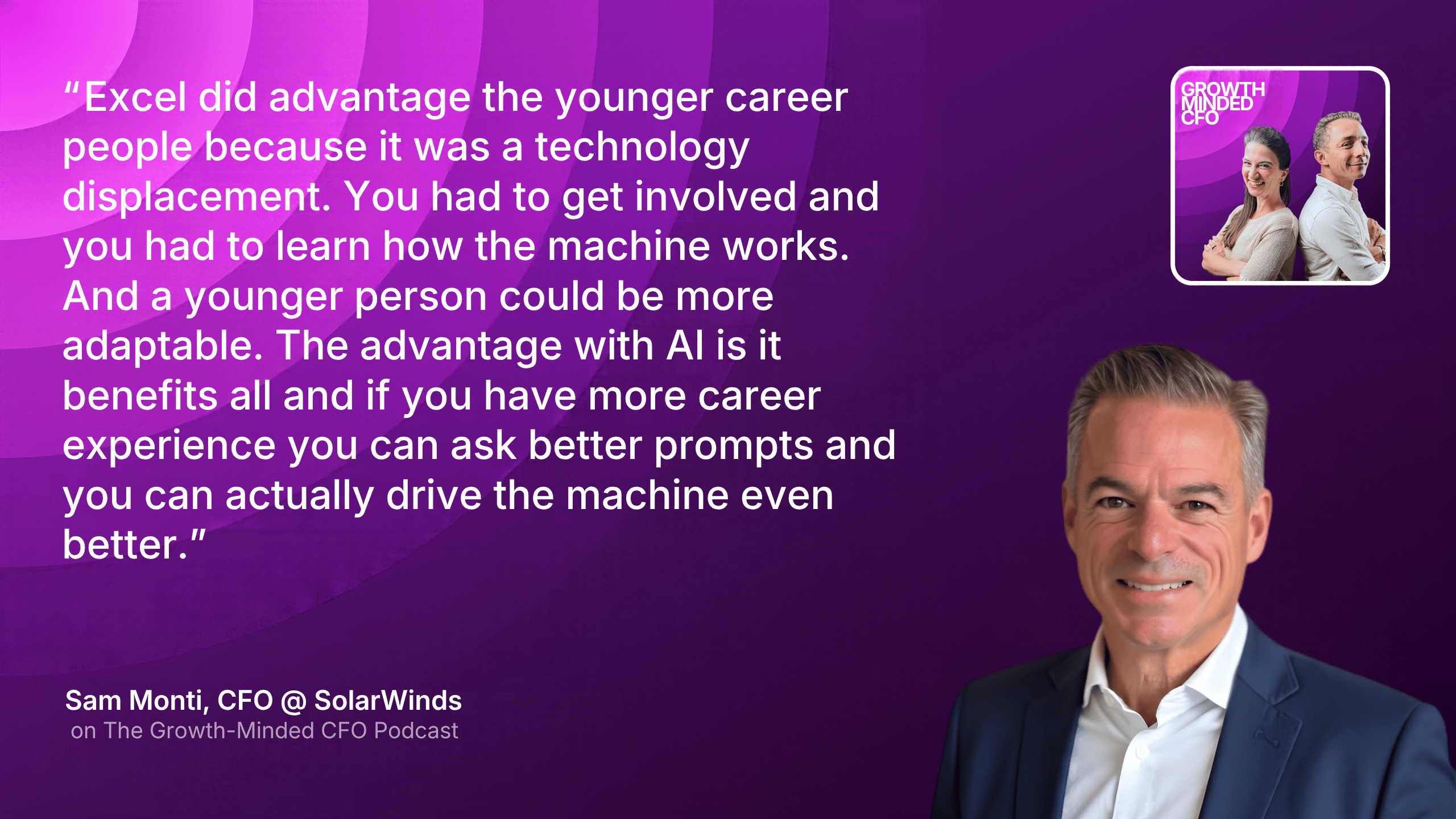
Sam believes experienced professionals have a particular advantage when using AI. While newer employees may be more familiar with emerging technology, experienced leaders bring years of industry knowledge and business context that help them ask better questions and get more useful results.
At SolarWinds, Sam has already seen AI create meaningful efficiencies across several areas of the business.
One example comes from the finance team's use of AI and FP&A technology. Tasks that previously required a full day of work, such as assembling weekly operational presentations, can now be completed in a fraction of the time.
That changes how the finance team spends its time. Instead of spending hours compiling information and formatting reports, employees can focus on understanding what the data is telling them and determining what the business should do next.
Sam is also excited about the potential for AI to transform forecasting. SolarWinds is implementing an FP&A system designed to support a rolling five-quarter forecast, allowing leadership to spend less time rebuilding annual budgets and more time evaluating incremental investments.
The financial picture becomes more visible, and conversations shift toward where the company should deploy additional capital to improve future performance.
For CFOs, this is the real opportunity with AI. The goal isn't simply to complete existing work faster. It's to fundamentally change how teams operate, allowing talented people to spend more time on higher-value activities.
The CFO Is Becoming the Company's Strategic Architect
Sam believes the traditional CFO role is undergoing a fundamental transformation.
For years, finance leaders were often viewed primarily as accountants, scorekeepers, and financial gatekeepers. Their responsibility was to report what happened, explain variances, and make sure the company stayed within its financial constraints.
But Sam believes the most successful CFOs are moving well beyond that traditional role.
He describes the modern CFO as a builder and architect, someone who serves as the CEO's primary strategy partner and helps determine where the business should go next.
That requires a different relationship with financial data.
Rather than simply looking backward at historical performance, CFOs need to use data, technology, and predictive analytics to anticipate what might happen before it becomes visible in the financial statements.
Sam uses the analogy of a fighter pilot to explain this evolution. Historically, pilots relied on their eyesight to identify potential threats. As technology advanced, radar gave them greater visibility, allowing them to identify targets from much farther away.
He believes the CFO's office is heading in the same direction.
With better data and technology, finance leaders can identify emerging patterns in market dynamics, recognize performance issues before they become significant problems, and help leadership make adjustments before results begin to deteriorate.
This also changes how finance teams should spend their time. If technology can automate reporting, forecasting, and other repetitive processes, the finance organization can dedicate more attention to evaluating investments, identifying opportunities, and helping the business make better decisions.
Ultimately, Sam believes CFOs should be asking not just where the company stands today, but where it's likely to be five quarters from now and what decisions can change that outcome.
The CFO's responsibility is no longer just to explain the numbers. It's to help shape what those numbers become.
For finance leaders willing to embrace that evolution, the opportunity is significant. Those who combine financial discipline with operational understanding, strategic thinking, and the ability to anticipate change will become some of the most influential leaders in the organization.
If you're a CFO or finance leader looking to become a stronger strategic partner to the CEO, this conversation offers a useful perspective on what that evolution looks like. Sam Monti shares practical frameworks for prioritizing investments, improving operational efficiency, navigating difficult business situations, and using AI to create more productive finance teams. His experience reinforces one central idea: the best CFOs aren't just keeping score. They're helping build the business.
Guest Appearance

Sam Monti
CFO @ SolarWinds

About
Sam Monti
Sam Monti is the CFO of SolarWinds, bringing more than 35 years of experience across finance and operations, including leadership roles as a CFO, COO, and CEO, giving him a perspective that extends beyond the numbers to how businesses operate, allocate capital, and grow. Before joining SolarWinds, he held CFO roles at companies including WP Engine and Epicor, and led a turnaround at CrownPeak, helping stabilize the business, rebuild its go-to-market organization, and return it to bookings growth. Today, he focuses on helping businesses operate more efficiently, deploy resources against their highest-impact priorities, and use data and technology to make finance a more strategic function.

Available on

We Are On Social


*based on our Listen Notes rating
**according to Datarails
© 2026 Growth Minded CFO